AI & Machine Learning Fundamentals Every Developer Should Know in 2026
A clear, practical introduction to AI and machine learning for software developers — covering supervised vs unsupervised learning, neural networks, training pipelines, and how to start building ML features into your own apps.
April 21, 2026 · 4.6K views
Table of Contents (10)
Why Every Developer Should Understand AI & Machine Learning in 2026 — and How to Get Started Without a PhD
In 2026, AI & Machine Learning is no longer a specialty reserved for PhDs — it has become a baseline skill that touches almost every software stack. From recommendation systems to fraud detection, from auto-complete in your IDE to image moderation in your SaaS, the line between "regular software" and "ML-powered software" has all but disappeared.
The good news is that you do not need to become a research scientist. As a software developer, your job is to integrate ML capabilities into reliable production systems. This guide gives you the mental model you need: enough theory to make smart architecture decisions, and enough practice to start shipping ML features this quarter.
Supervised vs Unsupervised vs Reinforcement Learning
There are three main learning paradigms you should know:
- Supervised learning — you give the model labeled examples (input → output) and it learns to predict the output. Use cases: spam detection, churn prediction, OCR.
- Unsupervised learning — the model finds patterns in unlabeled data. Use cases: customer segmentation, anomaly detection, topic modeling.
- Reinforcement learning — an agent learns by interacting with an environment and receiving rewards. Use cases: game AI, robotics, ad bidding.
For most product features, you will work with supervised learning, often via a pre-trained model that you fine-tune on your domain data.
Neural Networks Without the Math Wall
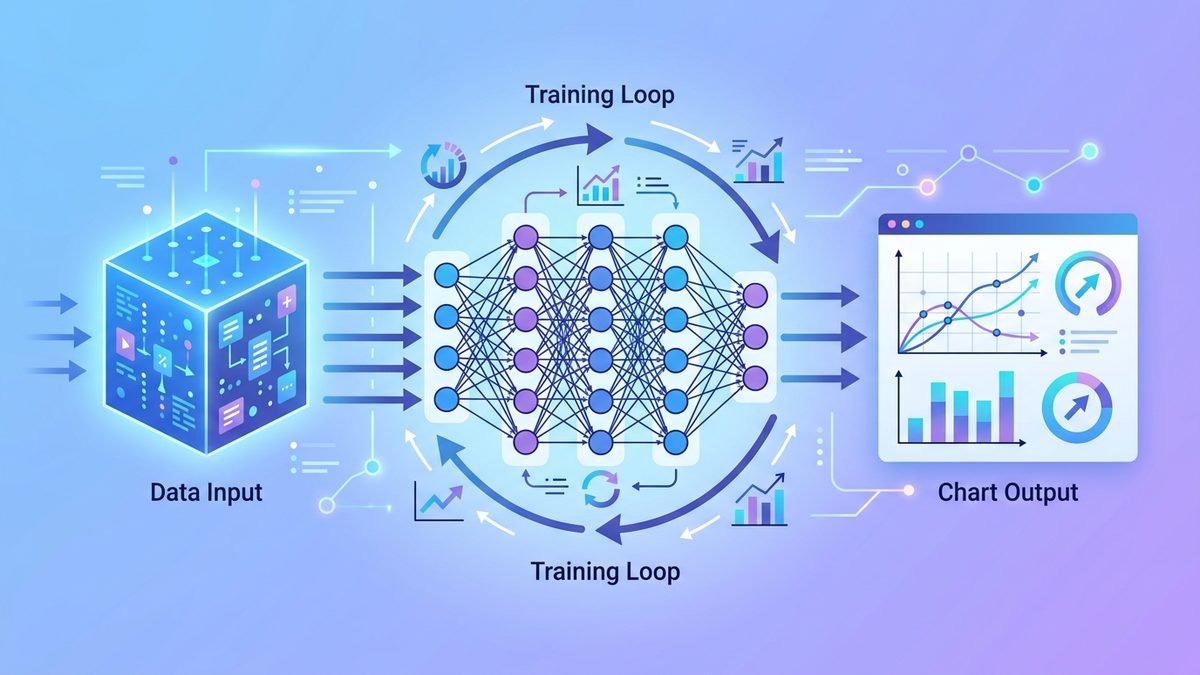
A neural network is just a stack of matrix multiplications and non-linear activations. Each layer transforms the input into a more useful representation, and the final layer produces a prediction. Training adjusts the weights using gradient descent so the loss (the difference between prediction and ground truth) goes down.
The key building blocks every developer should recognize:
- Tensors — n-dimensional arrays. Inputs, activations, weights, gradients are all tensors.
- Layers — Dense, Conv2D, LSTM, Attention. Each is a recipe for transforming tensors.
- Loss functions — cross-entropy for classification, MSE for regression, contrastive for embeddings.
- Optimizers — Adam is a safe default; AdamW with weight decay is even better for transformers.
- Regularization — dropout, batch norm, early stopping. These keep your model from memorizing the training set.
You do not need to implement these from scratch. Frameworks like PyTorch, JAX, and Keras 3 give you reusable, well-tested implementations.
A Pragmatic ML Workflow
Here is a battle-tested workflow you can apply to almost any ML problem:
- Frame the problem — is it classification, regression, ranking, or generation?
- Collect and label data — quality beats quantity nine times out of ten.
- Establish a baseline — a simple logistic regression or rule-based system. Many "AI" problems are solved well enough by a baseline.
- Iterate on the model — try a stronger architecture only when the baseline is exhausted.
- Evaluate honestly — use a held-out test set, multiple metrics, and check failure modes.
- Ship to production — wrap the model in a service, monitor latency, drift, and accuracy.
# A 10-line PyTorch training loop you will use a hundred times
for epoch in range(EPOCHS):
    for x, y in train_loader:
        pred = model(x)
        loss = loss_fn(pred, y)
        opt.zero_grad()
        loss.backward()
        opt.step()
    val_acc = evaluate(model, val_loader)
    print(f"epoch={epoch} val_acc={val_acc:.4f}")
How to Add ML Features to Your Existing App
Most teams do not need to train models from scratch. The fastest path to ML features in your app is:
- Use a hosted API — OpenAI, Anthropic, Google, Cohere, AWS Bedrock. Great for LLMs, embeddings, vision.
- Use an open-weights model — Llama 3, Mistral, Qwen via Hugging Face. Run on your own GPUs or cheap inference endpoints.
- Fine-tune a small model — when you have a narrow task and a few thousand labeled examples, a fine-tuned 7B model can beat GPT-4 on cost and quality.

Common Pitfalls to Avoid
- Data leakage — features that would not be available at prediction time sneak into training and inflate metrics.
- Imbalanced datasets — accuracy is misleading. Use precision, recall, AUC, and per-class metrics.
- Overfitting to a benchmark — your model wins on the leaderboard and loses on real users.
- Ignoring latency — a 600ms model that is 1% more accurate is often the wrong tradeoff.
- No monitoring — without drift detection and online metrics, your model silently degrades.
How to Evaluate a Model Honestly
Evaluation is where most teams cut corners — and where real problems hide. A model that scores 95% accuracy on the test set can still be useless in production. Always check:
- The right metric for the business problem. Accuracy is rarely the right one. For imbalanced classes, use precision, recall, F1, or ROC-AUC. For ranking problems, use NDCG or MAP. For regression, use MAE plus a calibration plot.
- A confusion matrix. Eyes on the actual errors will teach you more than any aggregate number.
- Per-segment metrics. A model that is 90% accurate overall but 60% accurate on your most valuable user segment is a bad model.
- Calibration. A predicted probability of 0.8 should mean "this happens 80% of the time" — verify it with a reliability diagram.
- Cost-aware metrics. A false negative in fraud detection costs the company money; a false positive annoys a customer. Reflect that in your scoring.
A Simple Mental Model for Production ML
Once your model is good enough offline, you have a whole new set of concerns. Production ML is 20% machine learning and 80% software engineering. Keep this checklist on hand:
- Versioning everywhere — code, data, and model artifacts. Use DVC, MLflow, or just git tags.
- Reproducible training — fixed seeds, pinned dependencies, deterministic preprocessing.
- Inference latency budget — measure p95 and p99, not just average. Some users always pay the long-tail cost.
- Online evaluation — compare model predictions to ground truth as it arrives, not just to a frozen test set.
- Drift detection — alert when input distribution or label distribution shifts beyond a threshold.
- A rollback plan — every model deployment must have a tested way to roll back to the previous version in under five minutes.
How to Keep Learning Without Burning Out
The ML field publishes thousands of papers a year. You cannot keep up — and you do not need to. The most useful learning loop for a working developer looks like this:
- Build something real every quarter. Pick a small project where ML solves a real problem in your life or your team's backlog.
- Read one excellent book a year, such as Hands-On Machine Learning by Aurélien Géron or Designing Machine Learning Systems by Chip Huyen.
- Follow three or four trustworthy blogs, not the entire feed. Quality over quantity always wins.
- Re-implement one classic paper annually. The act of writing the code teaches you what reading cannot.
Conclusion
You do not need to be a researcher to take advantage of AI & Machine Learning in 2026. Pick a real problem, build a strong baseline, integrate a hosted model or fine-tune a small one, and put proper monitoring around it. Do that three times, and you will have shipped more value than 90% of teams chasing shiny architectures. Welcome to applied ML — it is one of the highest-leverage skills you can develop as a software engineer this decade, and the best time to start is the next thirty minutes after you finish reading this article.
Share this article
Written by
AdminThe Topdevguide editorial team — covering AI, software development, and tech career trends across the USA & Australia.